.svg)



.webp)

LegalOn reviews every contract against your standards — attorney-built playbooks, written in plain English, covering 10,000+ legal issues.

Brief
AI contract review software reads your contracts, spots risk, flags non-standard language, and recommends changes in a fraction of the time it would take to do it manually. This year’s top AI contract review software options include LegalOn for in-house legal teams, Harvey for law firms, and Spellbook for budget-minded lawyers.
According to LegalOn’s 2026 State of AI for In-House Legal survey, legal teams spend an average of three hours reviewing a single contract. For teams reviewing 500 contracts a year, that translates to 188 out of 250 working days spent solely on contract review.
Whether you’re a solo general counsel or a contract manager in a ten-person legal team, the reality is this: a dedicated AI contract review tool is instrumental in saving time, reducing burnout, and increasing legal productivity.
LegalOn cuts contract review time by up to 85%, so your team can focus on the work that matters.
What is AI Contract Review Software?
AI contract review software uses artificial intelligence to scan legal documents, identify potential risks, highlight important clauses, and suggest changes based on your legal team’s playbooks.
Think of it as a powerful legal assistant that speeds up the review process and helps your team maintain high accuracy standards.
The best AI contract review software doesn’t disrupt your legal workflow or require months of involved implementation. Instead, it should supercharge your team’s productivity from day 1 and integrate with your existing tools, such as Microsoft Word and DocuSign.
Contract Review AI vs General AI
General AI tools aren't built for contract review. Unlike ChatGPT and Claude, contract review software is purpose-built specifically for contracts and legal documents.
And the difference matters. General AI lacks specialized legal training and misses subtle nuances that can expose your organization to risk.
In our 2026 Contract Review Benchmark study, we compared LegalOn to 11 general-purpose models across 3,282 contracts and 21 precision-critical contract guidelines. LegalOn ranked first across all provision types, while general AI failed on specific clause identifications, thresholds, multi-part requirements, cross-references, and absence checks.
General AI models can also be slower. LegalOn was 17x faster at contract review than Claude Opus 4.6, the strongest general-purpose model tested.
Unlike general AI, purpose-built tools are:
- Trained on contracts and legal documents
- Refined by contract attorneys (for example, LegalOn’s legal AI platform is built and maintained by lawyers)
- Calibrated for organization-specific compliance
- Designed for precision — recommendations align with legal standards and practices
Where general AI might identify glaring issues, a purpose-built platform like LegalOn's contract review tool identifies complex legal risks more quickly and more accurately than general models can.
How Can AI Help with Contract Review?
Contract review is one of the most time-consuming responsibilities in-house legal teams face.
AI contract review tools absorb the administrative burden, accelerate analysis, and give your team back the time and headspace to do work that actually requires a lawyer.
Here's what that looks like in practice.
Faster Contract Turnaround
AI contract review software instantly flags risk and generates precise redlines, guided by attorney-built playbooks that enforce your standards from day one. With built-in precedent search, it accelerates drafting and negotiation, so contracts that used to take days move in hours.
The result: 70–85% less time spent per contract.
More Time for Strategic Work
Routine reviews and basic risk identification don't require your best legal minds. AI handles tasks that can be automated. That frees your lawyers to focus on high-stakes negotiations, complex advisory work, and the decisions that actually matter.
The result: more capacity, fewer bottlenecks.
Consistent Risk Management
One of the quieter risks in contract review is inconsistency. Different reviewers, different standards, different outcomes. AI contract review tools apply your organization's playbooks uniformly.
You’ll achieve the same outcomes for each contract and every reviewer, every time. Customizable rules keep your team aligned with company policy and eliminate the gaps that create downstream risk.
The result: predictable contract terms and a stronger risk posture across the board.
LegalOn brings attorney-built intelligence to every contract review, so nothing slips through.
What Are the Challenges of Using AI for Contract Review?
AI contract review software delivers real value, but it's worth considering what implementation actually involves and where the technology has limits.
Not All AI Is Built for Legal Work
The most common challenge legal teams run into is choosing the right tool.
General-purpose AI models aren't trained on legal documents, don't understand contract-specific risk, and can hallucinate information with enough confidence to sound credible.
In contract review, that's a meaningful liability. Purpose-built legal AI, grounded in attorney expertise, addresses this directly, but it requires knowing what to look for when evaluating vendors.
Playbook Development Takes Investment
Pre-built playbooks get your team moving on day one. But for organizations with established legal standards, getting the AI to reflect your specific requirements — your preferred language, fallback positions, risk thresholds — takes time and input from your legal team. That investment pays off quickly, but it's real work upfront.
Lawyers Still Make the Final Call
AI contract review software may flag non-standard language and propose redlines, but it will never replace legal judgment.
Lawyers still need to review the output and apply context that the AI can't access, such as business relationship history and strategic priorities. AI is only the first-pass reviewer. You remain the primary decision-maker.
Change Management Is Often Underestimated
Introducing any new tool into a legal workflow requires buy-in. Lawyers who have reviewed contracts a certain way for years may be skeptical.
The teams that see the most durable results typically demonstrate the quality of AI output early and build confidence in the tool before relying on it heavily.
.svg)

Who Uses AI Contract Review Software?
In our 2026 survey of in-house legal teams, we discovered that 52% of teams are either actively using AI for contract review or evaluating solutions.
Legal teams of every size and structure use AI contract review. But the way teams put AI to work depends on where they sit and what they need.
In-House Legal Departments
For in-house counsel, AI contract review software delivers immediate, attorney-grade review without the overhead.
Smaller legal teams lean on pre-built playbooks to establish professional standards from day one. No lengthy implementation, no starting from scratch.
Mid-sized departments use that same foundation while layering in their own preferred language and standards. And enterprise legal teams deploy fully customizable playbooks that enforce consistency across global reviewers and contract managers at scale.
Contract Management, Procurement, and Compliance Teams
AI contract review isn't only for lawyers. Procurement managers, sales contract teams, and compliance officers use it to ensure every agreement holds to company standards — covering liability, IP protection, data security, and regulatory compliance — without routing everything through legal.
AI contract review tools, such as LegalOn, support contract management and procurement teams across industries such as construction, manufacturing, healthcare, SaaS, and technology.
Law Firms
For law firms, AI contract review creates capacity. Smaller firms can take on more clients and turn around work faster without adding headcount.
Larger firms can handle routine, lower-complexity work at competitive rates, while demonstrating to clients that efficiency is built into their operating model.
What Automated Contract Review Software Does For Legal Teams
At its core, automated contract review software does what a thorough attorney does during a first-pass review — only faster, and at a scale no individual reviewer can match. But the capabilities go beyond simply reading a contract.
Contract Risk Analysis
The first thing automated contract review software does when it opens a contract is look for problems.
It scans every clause against a defined set of legal standards, flags language that falls outside acceptable parameters, and prioritizes issues by severity, so your team isn't wading through a flat list of redlines trying to figure out what matters most.
Contract Redlining
Identifying a problem is only useful if you know how to fix it. Automated contract review software flags risks and proposes specific redline language to resolve them.
In purpose-built legal AI, those redlines are grounded in attorney-drafted standards. The result is proposed language that your team can accept, adjust, or use as a starting point for negotiation.
Contract Drafting Support
Many platforms also offer drafting assistance. Their precedent search tools surface relevant language from past agreements, helping you build new contracts faster and more consistently.
Rather than recalling from memory what language your team used in a similar deal six months ago, the software finds it and applies it for you.
Comparison and Version Control
Contract negotiations rarely end at the first draft. Automated review software tracks changes across versions, flags what the other side has modified, and ensures nothing slips through between redlines.
For teams managing multiple contracts in parallel, version control alone eliminates a significant source of error.
Clause Extraction and Reporting
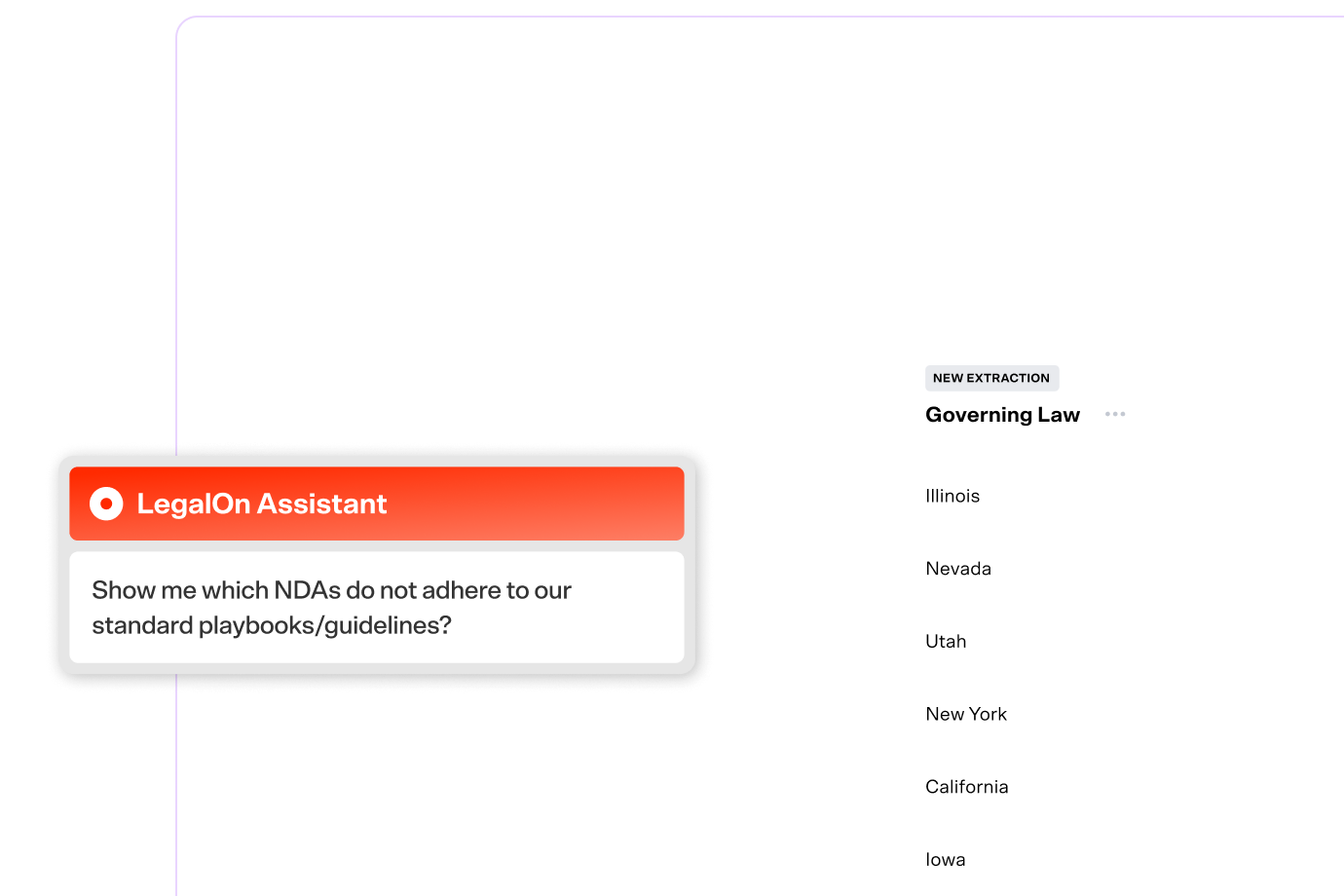
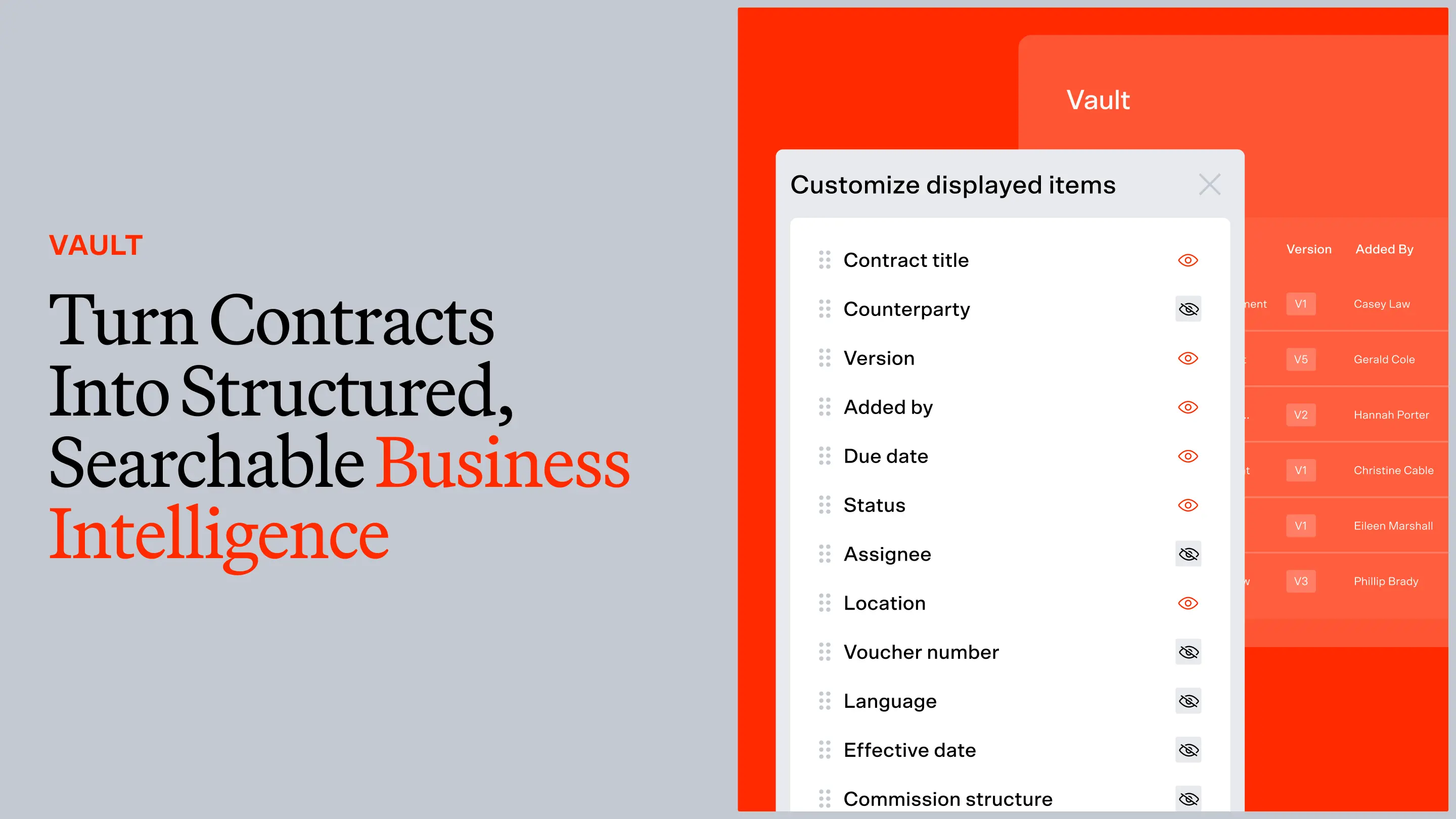
Beyond individual contract review, the software extracts and organizes key data, such as counterparty obligations and renewal clauses, into structured summaries.
For legal teams managing large contract portfolios, this turns agreements that would otherwise sit in static files into searchable, actionable data.
The Thread That Connects It All: Playbooks
An automated contract review tool is only as good as the standards it's working from. Without a defined set of rules telling the AI what your organization considers acceptable, you get generic output that may or may not reflect how your team actually works.
How AI Contract Review Software Works with Playbooks
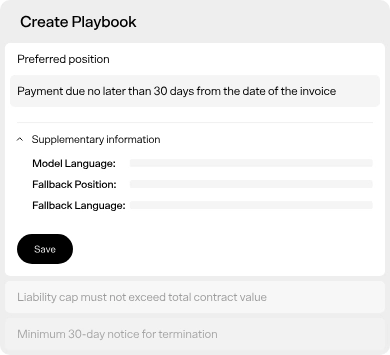
Contract review playbooks define how legal teams evaluate agreements.
In contract review AI tools, playbooks are the legal intelligence layer that turns a capable assistant into one that reviews contracts exactly the way your team would.
Playbooks encode your organization's standards, preferred language, fallback positions, and review protocols. When paired with AI, they act as guardrails that keep every analysis consistent and aligned with your requirements.
The problem is that most legal teams are working without them. Our survey found:
- 95% of legal teams have playbook gaps
- 42% rely on general or some comprehensive playbooks
- 34% have no playbooks at all
- 19% rely only on basic clause libraries
- Just 5% have comprehensive coverage.
Which means the majority of legal teams are reviewing contracts without a consistent standard to anchor them.
How Playbooks Actually Work Inside AI Contract Review Software
Think of a playbook as the rulebook your AI reviews every contract against.
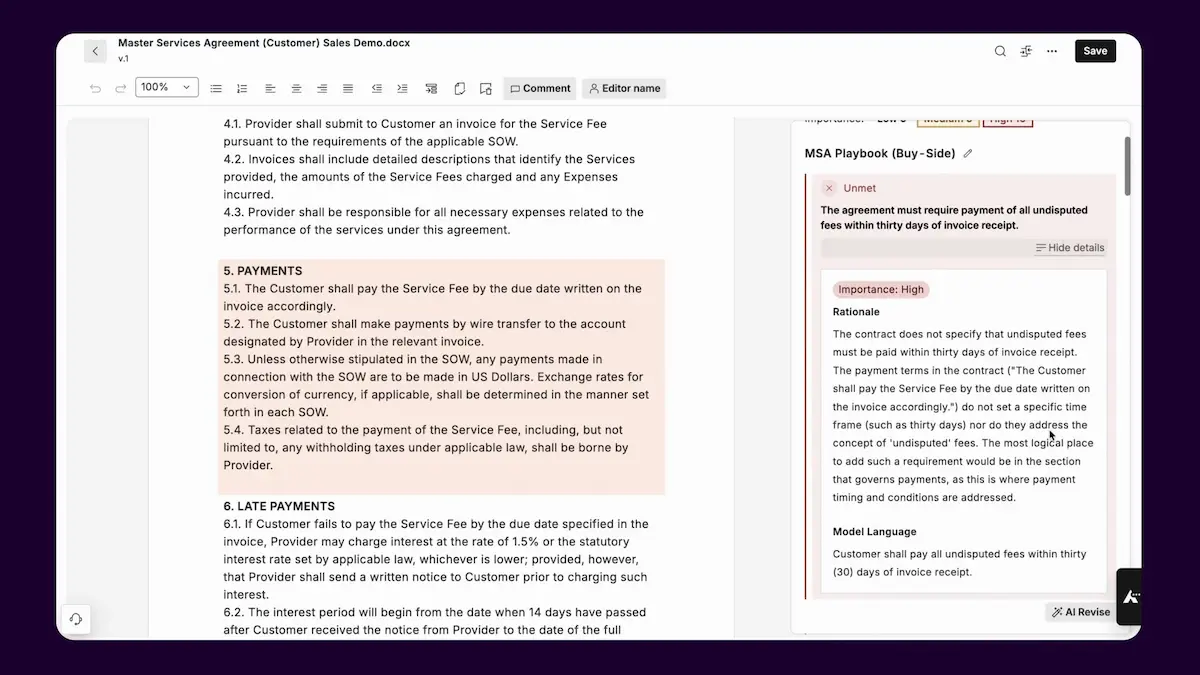
When you upload a contract, the AI doesn't just scan for generic risk. It checks every clause against the standards encoded in your playbook, such as:
- Your fallback positions on indemnification
- Your required data security language
- Your preferred limitation-of-liability cap
It then surfaces anything that falls outside them.
Where a clause is missing or non-standard, the AI generates a redline grounded in your own language.
That's the difference between AI contract review and a basic clause detector. A clause detector tells you what's in the contract. A playbook-driven AI tells you what's wrong with it and how to fix it, according to your standards.
Example of Playbooks-Based AI Contract Review
A vendor sends over an MSA. Your AI contract review software opens it and runs it against your playbook.
Within minutes, it returns a prioritized list of issues:
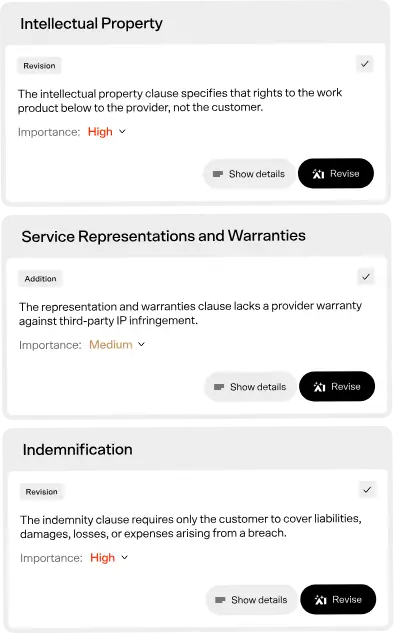
- The IP ownership clause assigns rights to the vendor rather than your organization.
- The limitation of liability is uncapped.
- There's no data breach notification requirement.
For each issue, the software proposes redline language that your team has already approved.
Your lawyer reviews the flagged issues, accepts or adjusts the redlines, and sends the contract back. What used to take hours is now done in minutes.
But the most valuable benefit? Consistency. Every reviewer, whether it's a senior associate or an in-house generalist picking up an overflow contract, applies the exact same standards.
No gaps. No one approving uncapped liability because they didn't catch it. No differing interpretations of what your organization actually requires.
That's what playbooks make possible: not just faster contract review, but better contract review every time.
LegalOn's Playbook Library
LegalOn’s legal content team has built a comprehensive suite of AI playbooks covering the agreements that in-house teams and law firms encounter most. A few examples:
- Business Associate Agreement
- Clinical Trial Agreement
- Consulting Services Agreement
- Construction Agreement
- Construction Subcontractor Agreement
- Data Processing Agreement
- Data Use Agreement
- Distribution Agreement
- Letter of Intent
- Manufacturing and Supply Agreement
- Master Construction Contract
- Master Construction Supply Agreement
- Master Design Build Contract
- Master Purchase Agreement
- Master Services Agreement
- Material Transfer Agreement
- Modified Gross Lease
- Non-Disclosure Agreement
- Office Lease Agreement
- Purchase of Goods Agreement
- SaaS Terms of Service
- Sales Agency Agreement
- Service Agreement with Deliverables
- Service Agreement
- Software Licensing Agreement
- Triple Net Lease
- Venue Rental Agreement
LegalOn reviews every contract against your standards — attorney-built playbooks, written in plain English, covering 10,000+ legal issues.
How to Evaluate AI Contract Review Software
Not all AI contract review tools are built the same way. Some are general-purpose AI with a legal coat of paint. Others are purpose-built for the specific demands of contract analysis and redlining.
Knowing the difference will save your team from a costly implementation that doesn't deliver.
Here's what to assess.
1. Legal Expertise Integration
This is the most important criterion, and the one most vendors obscure. A Stanford RegLab study found that generic AI models hallucinate legal information in case law. Even if hallucinations occur only 10% of the time, that's not an acceptable margin of error in contract review.
The best purpose-built legal AI has contract attorneys drafting and training its models.
Here’s what to look for in a tool:
- Legal AI that with attorney-vetted standards
- Pre-built playbooks you can begin using on day 1, and the ability to build your own
- Redlines with accompanying legal reasoning
- Consistent formatting that holds up across contract iterations
If a platform requires you to build all playbooks from scratch, offers no evidence of attorney involvement, or demands dozens of training hours before you can review a single contract, look elsewhere.
2. Purpose-Built Architecture
Many AI tools can touch contract review. Few are built exclusively for it.
There's a meaningful difference between a general-purpose AI that handles contracts as one use case among many, and a platform whose entire architecture — its models, its playbooks, its workflows — is designed around legal contract analysis.
3. Enterprise Security
Contracts contain some of your organization's most sensitive information: deal terms, liability exposure, and trade secrets.
At a minimum, look for SOC 2 Type II certification and compliance with GDPR and CCPA. Vendors should also offer a clear data usage policy that explicitly prohibits training AI models on your contracts, as well as enterprise access controls, including SSO, role-based permissions, and encryption at rest and in transit.
4. Day-One Productivity
Your legal team needs to be more productive now, not after a six-month implementation. Evaluate vendors on how quickly they can get your team to a productive review workflow.
How long it takes to set up the tool will depend on your specific circumstances:
- If you’re using pre-built playbooks: 1-2 days, no setup required
- If you’re integrating existing standards: 1-3 weeks
- If you’re building custom playbook libraries: 3+ months, depending on complexity
Whichever path applies to your team, the outcome benchmark is consistent: expect a 50–90% reduction in time per contract and the capacity to handle two to three times more contracts each week.
How to Implement AI Contract Review Software
There's no universal implementation path. The right one depends on where your team is starting from.
Start With Pre-Built Playbooks (If You're Starting From Scratch)
If your team doesn't have formal playbooks in place, don't let that stop you. Pre-built, attorney-vetted playbooks give you professional-grade review standards from day one.
This is the fastest path to value. Upload a contract, run it against an established playbook for that agreement type, and get prioritized flags and redlines back in minutes.
For smaller legal teams that need to move quickly and can't spend weeks building out review standards, this is often the right long-term approach as well.
Layer Your Standards on a Pre-Built Foundation (If You Have Existing Preferences)
If your team already has preferred language, established fallback positions, or internal review standards, but no formal playbook infrastructure, a hybrid approach gets you there faster than building from scratch.
Start with a pre-built playbook as the foundation, then customize it to reflect your organization's requirements. Preferred indemnification language. Your liability cap thresholds. The data security clauses your team always pushes for.
Within one to three weeks, you have an AI that reviews contracts against your specific standards.
This approach works well for mid-sized legal teams that want the speed of pre-built with the precision of something that actually reflects how they work.
Build Fully Custom Playbooks (If You're an Enterprise With Comprehensive Standards)
Large organizations with established legal protocols, global teams, and complex agreement portfolios need more than a pre-built starting point. They need AI that precisely reflects their standards across every reviewer, every jurisdiction, and every contract type.
A fully custom build means working from your existing playbooks, preferred language libraries, and internal policies to configure the AI to your specifications.
It takes longer, but the result is a system that enforces consistency at scale, without forcing your team to compromise on the standards they've spent years developing.
LegalOn for AI Contract Review Software
LegalOn is purpose-built for contract review. Here's what that means in practice.
Attorney-Built Legal Intelligence
The foundation of LegalOn's contract review is its legal content library: 10,000+ legal issues pre-built across 50+ contract types, each developed by contract attorneys.
Every issue includes guidance on what to look for, trusted contract language, and sample fallback clauses. The AI isn't just flagging problems, it's telling your team what to do about them.
Playbooks are reviewed and updated by practicing attorneys on an ongoing basis, keeping pace with evolving legal standards and market norms. The AI itself is trained on public legal sources and synthetic data developed by our legal experts, not on customer contracts.
Day One Productivity
Legal teams using LegalOn for AI contract review typically see 70–90% less time spent per contract. They can handle three times more agreements without adding headcount. In the first week alone, most teams are processing three to four times as many contracts as they did through manual review.
Technical Architecture
LegalOn combines large language models, machine learning, and natural language processing to identify risk across the full scope of a contract. Each review involves hundreds to thousands of individual AI calls, catching critical issues that simpler clause-detection tools routinely miss.
Enterprise-Grade Security
We’re SOC 2 Type II certified and compliant with GDPR and CCPA. Customer contracts are never used to train AI models. LegalOn’s legal AI platform provides enterprise-grade security controls for legal teams of all sizes, including SSO, role-based access controls, and encryption.
LegalOn keeps your contracts secure — and your data is never used to train AI models. Review with confidence.
Contract Review AI: FAQs
1. How accurate is AI contract review compared to manual review?
Purpose-built legal AI helps legal teams improve accuracy and risk detection compared to manual review. However, general AI tools (such as ChatGPT) can hallucinate legal advice. LegalOn's accuracy comes from attorney-drafted content and AI models trained on millions of actual contracts.
2. How much time can AI contract review software save?
Lawyers implementing AI contract review software, such as LegalOn, save up to 85% of review time per contract.
According to our research, legal teams typically spend an average of 3 hours reviewing a single contract. For a team handling 500 contracts a year, that's roughly 188 working days consumed by review alone.
AI contract review software significantly reduces that time. Most teams see a 70–85% reduction in time per contract.
3. Is AI contract review software secure for confidential legal documents?
AI contract review software is safe and secure for lawyers to use, provided vendors are clear about their security protocols. LegalOn provides SOC 2 Type II certification, GDPR and CCPA compliance, encrypted data at rest/transit, and segregated environments for each customer.
We maintain strict data isolation, and we never use customer contracts for AI training or share them with third parties.
4. Can AI contract review software handle complex contract types?
The best platforms handle 50+ contract types from day one, covering everything from Master Services Agreements and SaaS Terms of Service to highly specialized agreements like M&A transaction documents and data processing agreements governed by GDPR or CCPA.
What separates strong platforms from adequate ones is how they handle context. Contract language is rarely black-and-white.
For example, the difference between "reasonable efforts" and "best efforts” is a meaningful legal distinction that changes the obligations a party is agreeing to. Purpose-built legal AI is trained to recognize these.
5. What’s the biggest risk when choosing AI contract review software?
The biggest risk when choosing a contract review AI is selecting a generic LLM or a CLM add-on rather than a purpose-built tool.
The questions worth asking before you decide on a vendor: Are the playbooks pre-built by attorneys, or are you expected to build them yourself? Is the redline language attorney-drafted, or is it AI-generated with no legal grounding? Can the vendor point to the legal expertise behind the product?
LegalOn, for example, offers attorney-built content, pre-built playbooks across 50+ contract types, and legal intelligence that's ready to use from day one.
Ready to See What AI Contract Review Actually Looks Like?
Purpose-built AI contract review software is more than just a few AI-assisted redlines. It makes your whole team more productive, more consistent, and better positioned to focus on the work that requires a lawyer.