.svg)





Editor's note: This piece was originally published in October 2025 and updated in October 2026 to reflect the latest industry news and benchmark data.
In its 2026 survey of over 500 in-house legal leaders, Axiom found that 80% of teams plan to bring law firm work back in house. For most legal teams handling increasing workloads, automating routine tasks is no longer an option, and first-pass, high-volume contract review is the biggest lever they can pull.
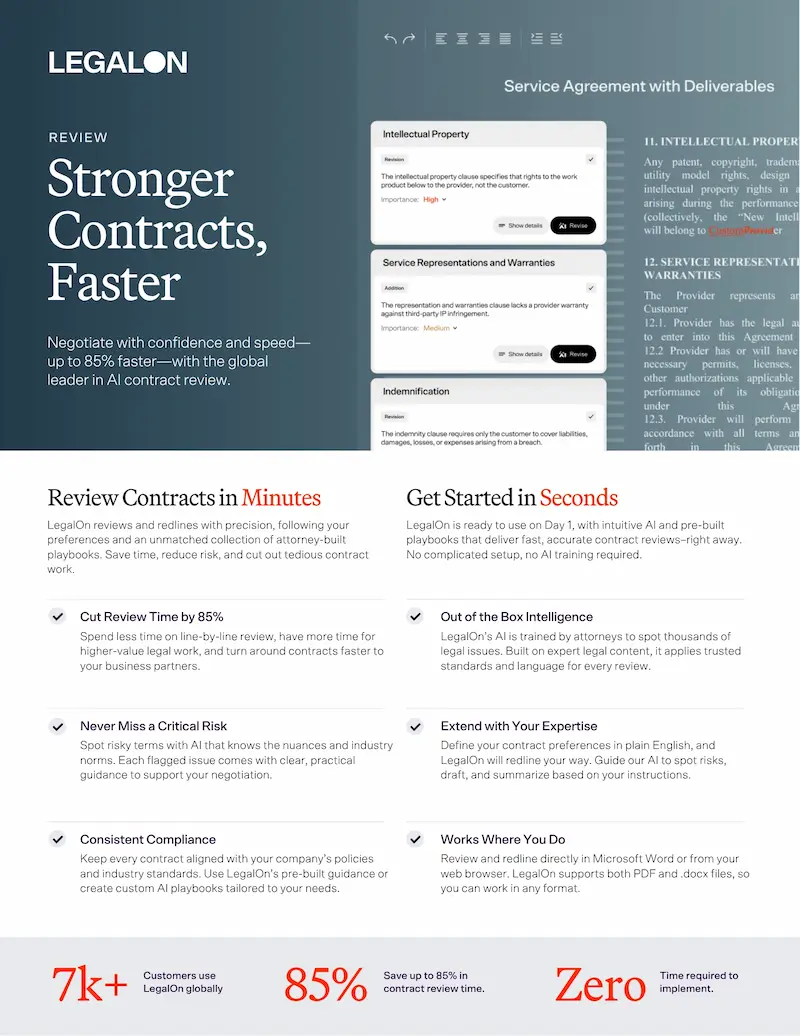
AI contract review software reads your contracts, flags risk, catches non-standard language, and proposes redlines in a fraction of the time manual review takes. For in-house legal teams, that’s the difference between half a day spent on a single contract versus minutes.
This guide covers what the software does, who uses it, how to evaluate it, and the best AI contract review software for in-house legal teams in 2026.
Stop spending your week on line-by-line markup. Book a demo to run LegalOn on your own contracts.
In this post:
What is AI contract review software?
What can AI contract review software do?
What to look for in AI contract review software
Best AI contract review software, ranked and compared
Benefits of using AI for contracts
Challenges of using AI for contracts
How to evaluate and choose AI contract review software tools
FAQs about AI contract review software
What is AI contract review software?
AI contract review software uses artificial intelligence to scan legal documents, flag risk, highlight important clauses, and suggest changes based on your legal team's playbooks.
The best review automation tools function like an AI-powered first-pass reviewer that understands legal context specific to your team. The strongest AI contract review software:
- Is purpose-built for legal work. That means it’s not a general chatbot pointed at a contract
- Offers attorney-built intelligence that grounds every flag and redline in legal standards
- Gets your team product on Day 1, so you’re reviewing real contracts within hours of setup
- Fits existing tools, including Microsoft Word and DocuSign, with no months-long rollout
→ Related Article: Best Automated Contract Review Software Tools of 2026
Who uses AI for contracts?
Legal teams of every size use AI contract review; 52% of in-house teams are already using it or actively evaluating solutions, per our 2026 State of AI for In-House Legal report.
Most commonly, these teams use it:
- In-house legal departments. For in-house counsel, AI delivers an attorney-grade first pass in minutes. Smaller teams rely on pre-built playbooks to set professional standards from day one. Mid-sized departments layer in their own preferred language. Enterprise teams deploy fully custom playbooks that hold global reviewers to one standard.
- Contract management, procurement, and compliance teams. Procurement managers, sales contract teams, and compliance officers use AI to hold every agreement to company standards on liability, IP protection, data security, and regulatory compliance, without routing everything through legal.
- Law firms. For law firms, AI creates capacity. Smaller firms take on more clients without adding headcount. Larger firms handle routine work at competitive rates and show clients that efficiency is built into how they operate.
How is AI contract review different from traditional contract review?
In traditional contract review, a lawyer reads a contract line by line, compares it against memory or a stack of precedent documents, and marks up issues by hand. It is slow, inconsistent from reviewer to reviewer, and impossible to scale as contract volume grows.
AI contract review automates that first pass and requires only human approval for individual redlines. That’s a significant difference—LegalOn’s customers do a first pass up to 85% faster after signing up on Day 1.
According to Axiom’s 2026 survey, only 31% of legal teams are using AI at scale, and 90% of teams face pressure to improve efficiency and productivity. Transitioning from manual to AI contract review is the best place for overburdened teams.
AI handles the mechanical first pass so your team applies judgment where it most counts for the business.
What can AI contract review software do?
At its core, AI contract review software does what a thorough attorney does on a first-pass review, only faster and at a scale no individual reviewer can match. It helps with:
- Contract risk analysis. The software scans every clause against a defined set of legal standards, flags language that falls outside acceptable parameters, and ranks issues by severity, so your team isn't sifting a flat list trying to work out what matters most.
- Contract redlining. Flagging a problem is only useful if you know how to fix it. AI tools propose specific redline language grounded in attorney-drafted standards, which your team can accept, adjust, or use as a negotiation starting point.
- Contract drafting support. Precedent search surfaces relevant language from past agreements, so you build new contracts from what your team has already approved instead of from memory.
- Comparison and version control. The software tracks changes across drafts, flags what the counterparty modified, and makes sure nothing slips through between redlines.
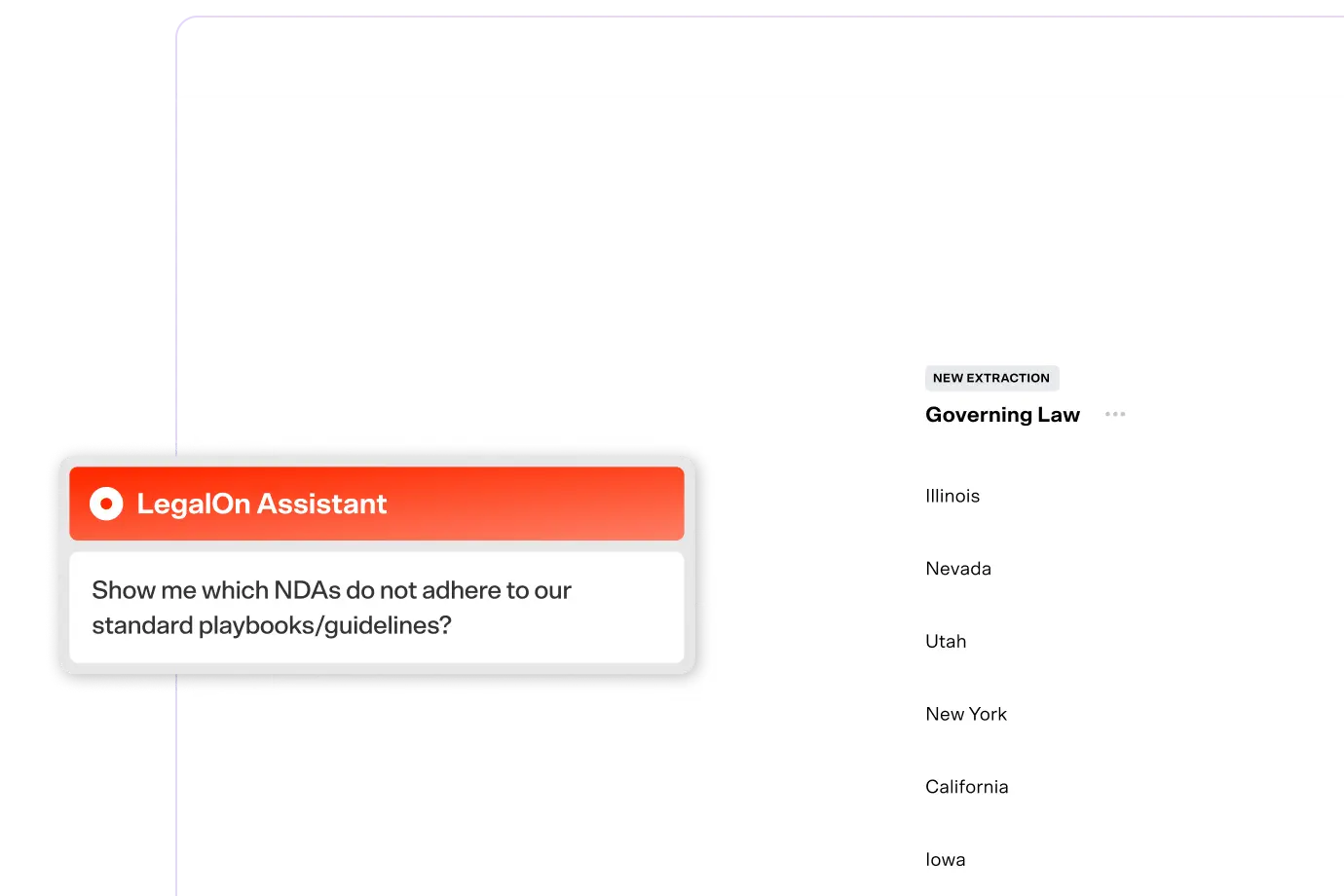
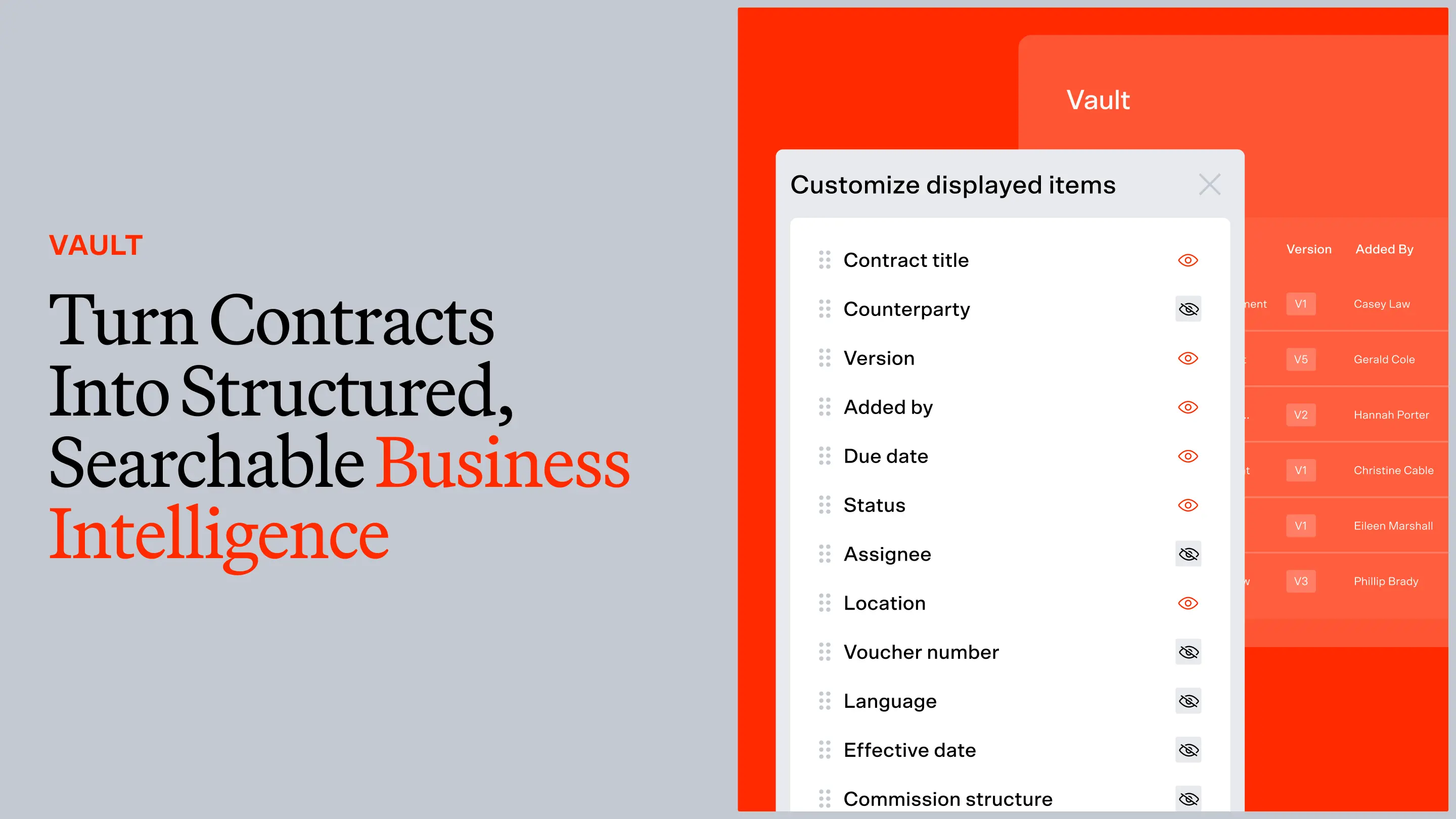
- Clause extraction and reporting. Beyond individual review, the software pulls counterparty obligations, renewal dates, and payment terms into structured summaries, turning static files into searchable, actionable data.
A note on general-purpose AI, which can help with some of these tasks. With Claude and ChatGPT widely available, why opt for specialized software? LegalOn's 2026 Contract Review Benchmark answers this directly.
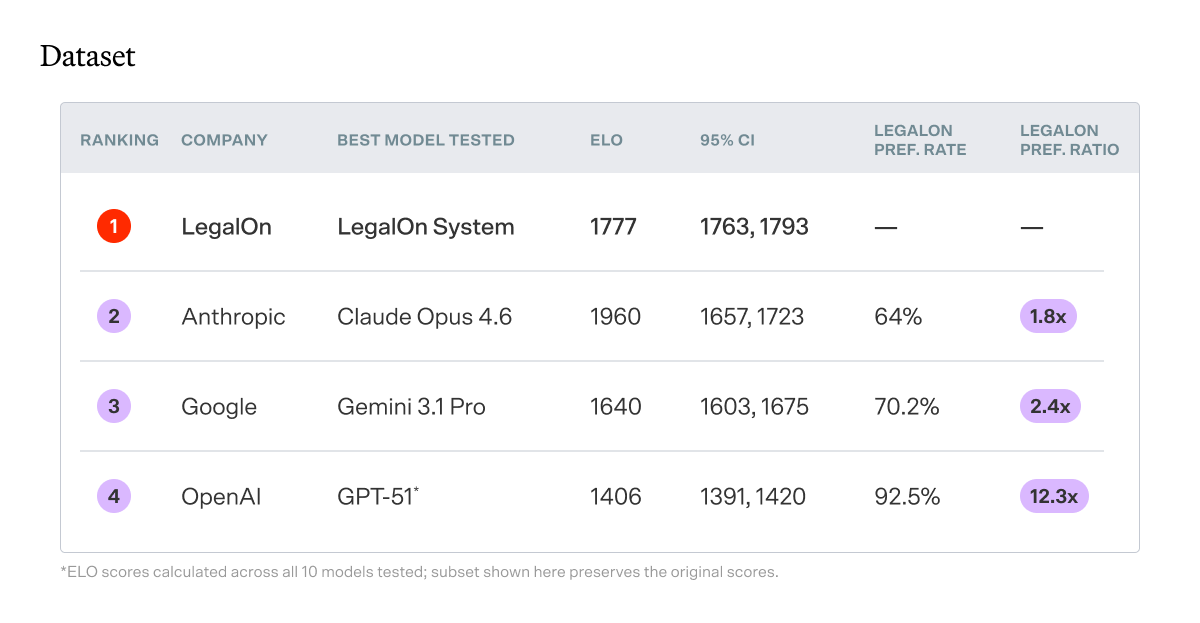
We compared LegalOn head-to-head against 11 AI models across 3,282 contracts and 21 precision-critical guidelines, judged by an independent LLM on correctness, evidence quality, article identification, completeness, and reasoning quality. We found:
- LegalOn outperformed every general-purpose model tested, including Claude Opus 4.6, Gemini 3.1 Pro, and GPT-5.1, across all 21 provision categories.
- LegalOn completed a full contract review in 2.3 seconds, 17x faster than Claude Opus 4.6, the strongest general-purpose model tested.
- General-purpose AI reliably found clauses but failed on precise language, numeric thresholds, multi-part requirements, cross-references, and absence checks.
General-purpose AI is a fine first step for contract review, as long as you don't end there. One missed liability cap or overlooked auto-renewal clause can cost far more than a year of software fees.
→ Related Article: ChatGPT for Contracts: Foundational Models vs. Lawyer-Trained AI
Use cases by industry

Construction Contract Review
Construction legal and project teams manage a heavy volume of interlocking agreements, from master contracts down to individual subcontracts, where a single missed term can put a project timeline or margin at risk.
- Common agreements: Master Construction Contracts, Construction Agreements, Construction Subcontractor Agreements, Master Design-Build Contracts, and Master Construction Supply Agreements.
- Terms that carry the most risk: payment terms, retainage, liquidated damages, delay penalties, termination rights, insurance requirements, and flow-down obligations to subcontractors.
- How AI helps: For construction companies, LegalOn flags risks, ranks them by severity, and provides attorney-vetted guidance so teams protect project timelines and margins while enforcing consistent risk standards across master contracts and every subcontract beneath them.
Uni-Structures, a 250-employee fabrication company that handles a high volume of subcontracts for major drive-thru restaurant chains, accelerated its sales contract reviews by over 90% with LegalOn.

Healthcare Contract Review
Healthcare and life sciences legal teams review contracts under some of the strictest regulatory scrutiny of any industry, where a compliance miss carries patient-safety and HIPAA consequences.
- Common agreements: Business Associate Agreements (BAAs), Clinical Trial Agreements (CTAs), Data Use Agreements (DUAs), Material Transfer Agreements (MTAs), Data Processing Agreements (DPAs), and NDAs.
- Terms that carry the most risk: HIPAA-driven terms, PHI use and disclosure, breach notification, IP protection, indemnification, and liability.
- How AI helps: LegalOn reads healthcare agreements for the terms that carry compliance and patient-safety risk and holds your positions on PHI, breach notification, and liability consistent across every department.
TriHealth, one of Greater Cincinnati's largest health systems, runs a six-attorney legal department that handles more than 1,500 contracts a year.
"Clinical trial agreements that used to take hours to review, we can now knock out in about 20 minutes with LegalOn—a 75% reduction in time." — Joseph Sgro, Associate General Counsel, TriHealth
The team saved 80+ hours with a Day 1 implementation.
→ Related Article: LegalOn's Suite of Healthcare and Life Sciences Contracts

Manufacturing Contract Review
Manufacturing legal, procurement, and sales teams negotiate supplier and distributor agreements where pricing, warranties, and product specifications directly affect production and margin.
- Common agreements: Master Purchase Agreements, Manufacturing and Supply Agreements, Distribution Agreements, and Purchase of Goods Agreements.
- Terms that carry the most risk: manufacturer warranties, exclusivity clauses, product specifications and change controls, delivery schedules, quality control measures, IP rights, and liability limits.
- How AI helps: At manufacturing firms, LegalOn identifies critical terms such as warranties, exclusivity, and specification changes, and proposes edits that protect your interests, so procurement approvals move faster while every vendor agreement honors your liability limits and keeps production lines running.
Contract review goes far beyond these. SaaS businesses, industrial companies, banks, and universities all benefit from implementing AI in contracting workflows.
What to look for in AI contract review software
Not every tool that touches contracts is built for legal review. Before you commit, hold each vendor to the criteria below.
- Attorney-built intelligence. This is the most important criterion and the one most vendors obscure. A Stanford RegLab study found that general-purpose AI models hallucinate legal information in case law. Even a 10% error rate is unacceptable in contract review. Look for contract attorneys drafting and training the models, redlines that come with legal reasoning, and evidence of ongoing attorney involvement.
- Pre-built playbooks. Teams that build playbooks from scratch spend weeks in configuration before reviewing a single contract. Look for pre-built playbooks developed by experienced attorneys, plus the ability to build and customize your own in plain English.
- Risk scoring. A good engine ranks findings by severity instead of returning a flat list, so your team knows exactly where to spend attention in a 60-page MSA. Look for attorney-grounded risk logic and thresholds you can calibrate to your risk tolerance.
- Redline suggestions. The best tools propose specific redline language that reflects your standards, so your team never starts a negotiation from a blank page.
- Generative summaries (AI assistance). Clause-level and contract-level summaries translate dense language into plain-English takeaways that speed up decisions and cut unnecessary escalations.
- Storage and obligation tracking. Renewal deadlines, notice periods, delivery milestones, and payment terms get captured during review, turning contract language into a record your team can monitor.
- Approval workflows. Configurable routing moves contracts through legal, sales, finance, and procurement with the context and audit trail attached, without pulling in IT.
- Enterprise security. At a minimum, require SOC 2 Type II certification and compliance with GDPR and CCPA, plus SSO, role-based access, and encryption. Non-negotiable: the vendor must never train its models on your contract data.
Best AI contract review software, ranked and compared
The market is diverse, and in-house teams have many options—so many that 49% of teams report confusion or bewilderment at which to choose.
It ultimately depends on the bottleneck. Most in-house teams would benefit from implementing a legal AI platform built for the full workday, which handles legal tasks from matter intake to storage.
Contract lifecycle management (CLM) platforms are a good enterprise choice, while purpose-built review tools are a friendlier option for small teams.
Here are the best AI contract review tools for 2026.
1. LegalOn: Best for In-House Legal Teams
The verdict: LegalOn delivers the fastest time-to-value for in-house legal teams, pairing pre-built attorney intelligence with a Word-native workflow. For overwhelmed general counsel who need results on day one, it’s the clear choice.
LegalOn handles risk flagging and redlining from Day 1. It ships with 135+ attorney-built playbooks covering the most common commercial contract types, from NDAs to MSAs to DPAs. Custom playbooks are built in plain English, and integrated matter management keeps intake and request tracking in the same platform.
Features:
- 135+ pre-built attorney playbooks
- Custom playbook builder in plain English
- Automated risk scoring
- Attorney-grounded redlines grounded in 10,000+ legal issues
- Multi-language review
- Microsoft Word integration
- SOC 2 Type II certification
- Integrated matter management
Pros:
- Ranked first across all 21 provision categories in LegalOn's 2026 Contract Review Benchmark
- Day 1 productivity with no training period
- Attorney-built legal content, updated regularly
- Works inside Word
Cons
- Ideal for review and negotiation rather than the full contract lifecycle
- Not a fit for teams reviewing fewer than five contracts a month
Pricing: LegalOn offers custom-built pricing scoped to your team’s needs; book a demo to get a quote.
See LegalOn's AI contract review in action. Book a demo →
2. Harvey: Best for Law Firms
The verdict: Harvey is built for elite law firms, with a custom-trained AI that spans litigation, corporate, tax, employment, and regulatory work. For Am Law 100 firms handling complex, multi-matter work, it is an excellent option.
Features:
- General legal AI across practice areas
- Custom training on a firm's precedents and house style
- Research and drafting support
- Workflow tools for multi-matter work
Pros:
- Breadth across practice areas
- A single AI that follows attorneys across matter types
- Strong fit for large firms that want firm-wide deployment
Cons:
- Lengthy onboarding
- Contract-review accuracy typically lags behind dedicated review tools
- Priced for large-firm budgets
Pricing: Enterprise, per-seat pricing; contact Harvey for a quote.
3. GC AI: Best for In-House Legal Research
The verdict: GC AI is a broad AI workspace built for in-house counsel, covering commercial contracts, research, and day-to-day legal work in one place. For a contract-heavy in-house team that also wants research and drafting in the same tool, it is a strong option.
Features:
- Contract review and redlining inside a Microsoft Word add-in
- Drafting and summarization
- An AI assistant with cited answers
- Legal research, covering over 13M+ US federal and state court opinions (available as an add-on on the Individual plan; included on Team)
Pros:
- Free trial available
- SOC 2 Type II compliant
- Fast to start with no seat minimum
Cons:
- Research surface is lighter than research-first platforms
- Only 4 pre-built playbooks available
Pricing: $500 per seat per month (Individual); custom quote (Team).
4. Spellbook: Best for Contract Drafting in Word
The verdict: If a Word-native review tool isn't in budget or your team needs more drafting support, Spellbook is a strong choice. Its Word add-in generates clause suggestions and draft language as you work.
For solo practitioners and small-firm attorneys who draft from scratch, Spellbook is a capable drafting copilot. Teams that primarily review on counterparty paper will get more from LegalOn.
Features:
- Microsoft Word add-in
- AI clause generation and drafting
- Playbook-based review that flags off-standard clauses
- Benchmarking feature that compares terms against market data
Pros:
- Lower-cost pricing
- Fast to adopt
- Genuinely useful for drafting from a blank page
Cons:
- Drafting-focused and weaker on systematic, high-volume review
- Limited collaboration features
Pricing: Custom; contact Spellbook for a quote.
5. CoCounsel: Best for Research-Heavy Firms
The verdict: CoCounsel, Thomson Reuters' AI legal assistant, grounds its output in Westlaw and Practical Law content, which makes it a strong fit for in-house teams whose work is research-heavy and who already live in the Thomson Reuters ecosystem. Contract analysis is one capability within a broader research-and-drafting platform.
Features:
- Legal research with verified Westlaw citations
- Document review and contract analysis, drafting, deposition preparation, and agentic Deep Research
- Works in the web app and in Microsoft Word, Outlook, and Teams
Pros:
- Westlaw and Practical Law integration reduces case-law hallucination risk
- Deep research capability
Cons:
- Requires a Westlaw Advantage subscription, so total cost runs high
- Heavier option for contract-only in-house team needs
Pricing: Starts at $637/mo for 1 Law Firm seat, and $1,779/mo for 1 Business seat; pricing varies depending on sector, number of attorneys, jurisdiction, and plan duration.
6. Ironclad: Best for Enterprise Contract Lifecycle Management
The verdict: For enterprises that need a single system of record across the full contract lifecycle, Ironclad is an excellent CLM. Its real strength is workflow automation and repository management at scale, with AI review as one feature within a broader system.
Many large enterprises pair the two, using Ironclad as the CLM backbone and LegalOn for AI-powered review and negotiation.
Features:
- Contract intake
- Approval routing
- Obligation management
- Audit trails
- E-signatures
- AI-powered searchable repository
Pros:
- End-to-end lifecycle coverage
- Strong workflow automation and reporting
- Scales across business units
Cons:
- AI review lags dedicated review tools on accuracy and depth
- Long implementation
Pricing: Custom; contact Ironclad for a quote.
7. Workday CLM (Formerly Evisort): Best for Contract Intelligence at Scale
The verdict: Formerly the standalone Evisort platform, Workday Contract Lifecycle Management is powered by Evisort AI and offers AI extraction and analytics across a large contract repository. It’s most cost-effective for organizations already running Workday.
Features:
- AI clause and metadata extraction
- Contract analytics and reporting
- Searchable repository
- An "Ask AI" natural-language query experience
- Lifecycle workflows from intake through renewal
Pros:
- No-code workflow configuration
- Native to the Workday suite
Cons:
- No standalone purchase since the Workday acquisition
- Oriented to lifecycle and analytics rather than attorney-grounded first-pass review
Pricing: Custom; contact Workday for a quote.
Compare LegalOn against any tool on this list. Book a demo →
Benefits of using AI for contracts
Contract review is one of the most time-consuming tasks in-house legal teams do day-to-day. AI absorbs the administrative burden and gives your team back the time and headspace for the work that actually requires a lawyer.
In our 2026 State of AI for In-House Legal report, 79% of teams reported spending less time on routine legal tasks, and 67% said AI helps them respond faster to the business.
Automating contract review can also help performance. In BarkerGilmore’s In-House Counsel Compensation Report, 81% of GC’s report performance constraints due to lack of resources or staffing. That’s a gap AI contract review software fills.
The benefits are clear:
Faster contract turnaround
AI instantly flags risk and generates precise redlines, guided by attorney-built playbooks that enforce your standards from day one. With built-in precedent search, contracts that once took days move in hours.
More time for strategic work
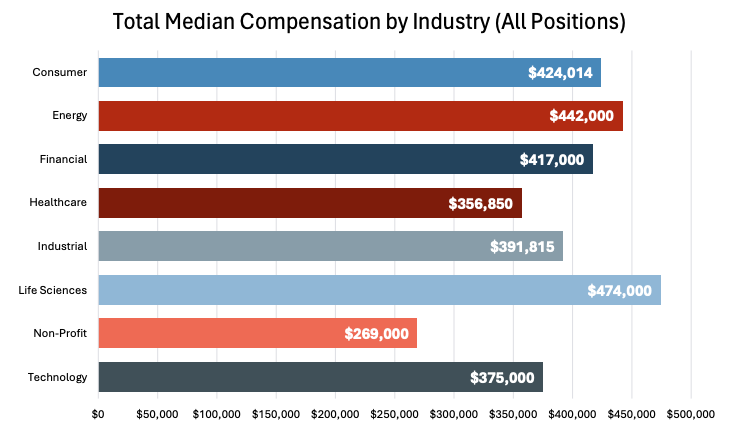
When your business’ brightest minds are strapped with manual, time-consuming work, the cost is exorbitant. In 2025, the median salary for a General Counsel, Managing Counsel, and Senior Counsel across several industries was $404,407. If spent mostly on contract review, that’s difficult to justify.
Routine reviews and basic risk identification don't require your best legal minds or their valuable hours. AI handles what can be automated, which frees your lawyers for high-stakes negotiations, complex advisory work, and the decisions that move the business.
Consistent risk management
One of the quieter risks in contract review is inconsistency. Different reviewers apply different standards, leading to different outcomes. AI applies your playbooks uniformly, so a senior associate and an in-house generalist picking up an overflow contract reach the same result. Customizable rules keep the team aligned with company policy and close the gaps that create downstream risk.
Bring attorney-built intelligence to every review. Book a demo →
Challenges of using AI for contracts
AI contract review delivers real value, but it is worth being clear-eyed about where the technology has limits.
- Not all AI is built for legal work. The most common mistake is choosing the wrong tool. General-purpose models aren't trained on legal documents and can hallucinate with enough confidence to sound credible. A legal AI platform grounded in attorney expertise addresses this, but only if you know what to look for when evaluating vendors.
- Playbook development takes investment. Pre-built playbooks get your team moving on day one. But building playbooks based on your fallback positions and risk thresholds takes time and input from your legal team. That investment pays off quickly, but it is real work upfront.
- Lawyers still make the final call. AI flags non-standard language and proposes redlines that still require legal judgment. Lawyers apply context the AI can't access, from relationship history to strategic priorities. AI is the first-pass reviewer; you remain the decision-maker.
- Change management is often underestimated. Any new tool in a legal workflow needs buy-in, and lawyers who have reviewed contracts a certain way for years may be skeptical. Teams that see durable results tend to demonstrate output quality early and build confidence before relying on the tool.
→ Related Article: Contract Related Business Mistakes
The key: Playbooks
An AI contract review tool is only as good as the standards it works from. Without a defined set of rules telling the AI what your organization considers acceptable, you get generic output that may or may not reflect how your team works.
Contract review playbooks define how legal teams evaluate agreements. They encode your standards, preferred language, fallback positions, and review protocols. Paired with AI, they act as guardrails that keep every analysis consistent and aligned with your requirements.
The problem is that most legal teams work without them. Our 2026 State of AI for In-House Legal report found:
- 95% of legal teams have playbook gaps
- 42% rely on general or some comprehensive playbooks
- 34% have no playbooks at all
- 19% rely only on basic clause libraries
- Just 5% have comprehensive coverage
Which means most legal teams review contracts without a consistent standard to anchor them.
How playbooks work inside AI contract review software
Think of a playbook as the rulebook your AI reviews every contract against. When you upload a contract, the AI checks every clause against the standards your playbook encodes, such as:
- Your fallback positions on indemnification
- Your required data security language
- Your preferred limitation-of-liability cap
Where a clause is missing or non-standard, the AI generates a redline grounded in your own language. That is the difference between AI contract review and a basic clause detector: a clause detector tells you what's in the contract, while a playbook-driven AI tool tells you what's wrong with it and how to fix it.
Example of playbook-based AI contract review
A vendor sends over an MSA. Your AI contract review software opens it, runs it against your playbook, and within minutes returns a prioritized list of issues:
- The IP ownership clause assigns rights to the vendor rather than your organization.
- The limitation of liability is uncapped.
- There's no data breach notification requirement.
For each issue, the software proposes redlines your team has already approved. Your lawyer reviews the flags, accepts or adjusts the redlines, and sends the contract back. What used to take hours is done in minutes.
The most valuable benefit is consistency. Every reviewer applies the same standards.
LegalOn's playbook library
LegalOn's legal content team has built a comprehensive suite of AI playbooks covering the agreements in-house teams and law firms encounter most, including:
- Business Associate Agreement
- Clinical Trial Agreement
- Construction Agreement
- Data Processing Agreement
- Distribution Agreement
- Manufacturing and Supply Agreement
- Master Purchase Agreement
- Master Services Agreement
- Non-Disclosure Agreement
- SaaS Terms of Service
LegalOn reviews every contract against your standards using 135+ attorney-built playbooks, written in plain English, covering 10,000+ legal issues.
How to evaluate and choose AI contract review software tools
Some tools are general-purpose AI with a legal coat of paint. Others are purpose-built for the demands of contract analysis and redlining. Knowing the difference will save your team from a costly implementation that doesn't deliver.
1. Verify the legal expertise behind the AI
Ask who built and trained the models. The best purpose-built legal AI has contract attorneys drafting and maintaining its content. Look for:
- Attorney-vetted standards behind every flag and redline
- Pre-built playbooks you can use on Day 1, plus the ability to build your own
- Redlines that come with legal reasoning
- Consistent formatting that holds up across contract versions
If a platform makes you build every playbook from scratch or shows no evidence of attorney involvement, look elsewhere.
2. Confirm the tool is built for contract review
Many AI tools can touch contract review, but few are built exclusively for it. There's a real difference between a general-purpose AI that treats contracts as one use case among many and a platform whose playbooks and workflows are all designed around legal contract analysis.
4. Check enterprise security and data controls
According to Axiom’s 2026 survey of in-house leaders, 44% of teams have concerns about security when adopting AI. With good reason: Contracts hold some of your organization's most sensitive information, such as deal terms, liability exposure, and trade secrets.
At a minimum, your tool should have:
- SOC 2 Type II certification
- GDPR and CCPA compliance
- SSO, role-based permissions, and encryption at rest and in transit
- A written policy that prohibits training AI models on your contracts
5. Evaluate implementation times
A six-month rollout benefits no one when the contract backlog keeps growing. Evaluate how fast each vendor gets you to a productive review workflow. Setup time depends on your starting point:
- Pre-built playbooks: 1–2 days, no setup required
- Integrating existing standards: 1–3 weeks
- Building custom playbook libraries: 3+ months, depending on complexity
Whichever path applies, the outcome benchmark is consistent. Expect a 50–90% reduction in time per contract and the capacity to handle two to three times more contracts each week.
6. Match the rollout to where your team starts
There's no universal implementation path. Choose the one that fits your starting point:
- Starting from scratch: Begin with pre-built, attorney-vetted playbooks. Upload a contract, run it against an established playbook, and get prioritized flags and redlines back in minutes. This is the fastest path to value, and often the right long-term approach for smaller teams.
- You have existing preferences: Start with a pre-built playbook as the foundation, then customize it with your preferred indemnification language, liability-cap thresholds, and data security clauses. Within one to three weeks, you have an AI that reviews against your specific standards.
- You're an enterprise with comprehensive standards: Build fully custom playbooks from your existing libraries and internal policies. It takes longer, and the result enforces consistency across every reviewer, jurisdiction, and contract type without compromising the standards you've spent years developing.
FAQs about AI contract review software
How accurate is AI contract review compared to manual review?
Purpose-built legal AI improves accuracy and risk detection compared to manual review, while general AI tools like ChatGPT can hallucinate legal advice. LegalOn's accuracy comes from attorney-drafted content and models validated by attorneys.
In LegalOn's 2026 Contract Review Benchmark, LegalOn outperformed 11 general-purpose models across all 21 provision categories tested. The most meaningful accuracy metric is the F1 score, which balances catching real issues against avoiding false positives; LegalOn targets 90%+ F1 performance across its playbooks.
How much time can AI contract review software save?
Teams using AI contract review software like LegalOn save up to 85% of review time per contract, and most see a 70–85% reduction. In the 2026 State of AI for In-House Legal report, 79% of teams reported spending less time on routine legal tasks and 67% said AI helps them respond faster to the business. Using LegalOn’s contract review tool, TriHealth cut clinical trial agreement review time by 75%, from hours to about 20 minutes per agreement.
Is AI contract review software secure for confidential legal documents?
Yes, provided the vendor is clear about its security protocols. LegalOn is SOC 2 Type II certified, compliant with GDPR and CCPA, and encrypts data at rest and in transit, with segregated environments for each customer. LegalOn never uses customer contracts for AI training or shares them with third parties.
Can AI contract review software handle complex contract types?
The best platforms handle 100+ contract types from Day 1, from Master Services Agreements and SaaS Terms of Service to specialized agreements like M&A documents and DPAs governed by GDPR or CCPA.
Context handling is essential, since contract language is rarely black-and-white. The difference between "reasonable efforts" and "best efforts" is a meaningful legal distinction that changes a party's obligations. Purpose-built legal AI is trained to recognize these.
What's the biggest risk when choosing AI contract review software?
The biggest risk is selecting a generic LLM or a CLM add-on instead of a purpose-built tool. Before you commit, ask: Are the playbooks pre-built by attorneys, or are you expected to build them yourself? Is the redline language attorney-drafted, or AI-generated with no legal grounding? Can the vendor point to the legal expertise behind the product?
LegalOn offers attorney-built content, pre-built playbooks across 135+ contract types, and legal intelligence ready to use from Day 1.
LegalOn for AI contract review software
For in-house teams needing a contract AI tool that’s ready on Day 1, LegalOn offers:
- Attorney-built legal intelligence. LegalOn's legal content library covers 10,000+ legal issues across 135+ contract types, each developed by contract attorneys. Every issue includes trusted contract language and sample fallback clauses. Practicing attorneys review and update the playbooks on an ongoing basis. The AI is trained on public legal sources and data developed by our legal content team.
- Day 1 productivity. Teams using LegalOn typically see 70–90% less time spent per contract and handle three times more agreements without adding headcount. In the first week alone, most teams process three to four times as many contracts as they did through manual review.
- Purpose-built architecture. LegalOn combines large language models, machine learning, and natural language processing to identify risk across the full scope of a contract. Each review runs hundreds to thousands of individual AI calls, catching issues that simpler clause-detection tools miss.
- Enterprise-grade security. LegalOn is SOC 2 Type II certified and compliant with GDPR and CCPA, with SSO, role-based access controls, and encryption. LegalOn never uses customer contracts to train its AI models.
Purpose-built AI contract review is more than a few AI-assisted redlines. It makes your whole team more productive and more consistent, and better positioned to focus on the work that requires a lawyer.
See what AI contract review actually looks like. Book a demo with LegalOn →